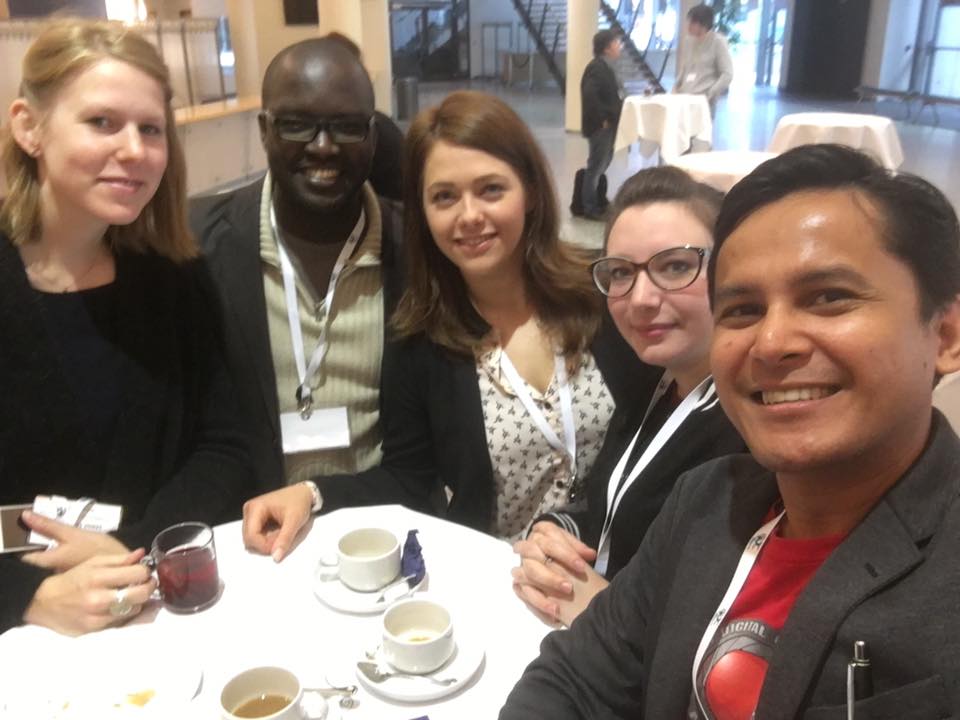
Post Supervisor, Participant of the EP2C (now APostLab) Annual Workshop in Halle, Germany, 2016
You were a participant in the 2016 EP2C/ APostLab workshop in Halle, Germany. What made you decide to apply to this training nine years ago?
Actually, it took me three tries to get in! I think I first applied around 2013. I didn’t know much about the program then, I probably saw it through an email list and thought, “Why not try?” I was rejected twice, and on the third try, they said, “We remember you, let’s give it a go.”
I didn’t realize I would be the first Asian post producer to ever join the program. That was really exciting and an eye-opener for me.
At that time, I had just finished editing a feature film called Redha — the first Malay film that represented Malaysia for the Oscars. I wasn’t officially a post supervisor, but the producer asked me to handle everything in post because no one really understood that role yet.
So when I attended the workshop in Halle, I realized that what I was doing was actually post supervision. That’s when it clicked for me.
Did that experience changed how you saw your role in post-production?
Completely. Back then in Malaysia, editors usually did everything — editing, sound, delivery — because we didn’t have post supervisors.
After EP2C/ APostLab, I finally understood how the European industry works. Doing breakdowns with Niko and the team opened my eyes to how structured post-production could be.
When I came home, I decided to officially take on post supervision as my main role. Today, I’m one of the few post supervisors in Malaysia who can handle anything from small projects to big-budget films.
Has the role of post supervisor grown in Malaysia since then?
Yes, it’s growing fast. I’ve trained a few post producers along the way. I also teach at four universities and introduced post supervision as part of their film studies.
Before, students only learned about editing and color grading, but now they also study what a post supervisor actually does.
It sounds like you’ve really helped shape this field in Malaysia?
I really owe that to EP2C/ APostLab. The exposure opened my mind about what a post supervisor’s job really is.
A few years later, another Malaysian producer joined the lab — Foo Fei Ling, who produced Tiger Stripes, which won at Cannes two years ago. I was the post supervisor for that film, at least in the early stages, since it was a seven-country collaboration.
You’re now also the president of the Post Production Professional Association in Malaysia. Can you tell us about that?
Yes! it’s called MyPostPro (mypostpro.my). As president, I’m working to make it standard that every film in Malaysia hires a post supervisor.
We’re now an official panel with the National Film Development Board of Malaysia (FINAS). They only approve post-production grants if a post supervisor is attached to the project.
It’s really changed the industry, we’ve raised professionalism, pay scales, and awareness of the importance of post.
That’s an incredible achievement. What would you say makes a successful collaboration between a producer and a post supervisor?
Respect. Producers need to see the post supervisor as the person who gives them peace of mind during post-production. Without one, producers end up chasing deadlines, talking to ten different people, and getting lost in technical issues. When you have a post supervisor, you can actually sleep at night, because that’s our job.
If you think back to nine years ago, what’s one key moment or skill you still remember from the workshop?
The session on post-production budgeting really stuck with me. We had to break down post budgets based on the script. When we compared the costs, everyone was shocked that Malaysia was so cheap, even though I had doubled our usual rates!
That was when I realized how undervalued and underpaid we were. It motivated me to raise professional standards when I came home, and we’ve made big progress since then.
If someone new wanted to become a post supervisor, what advice would you give them?
You need two things: passion and patience.
With those two, you can survive this industry. I’ve been doing this for 25 years, and I still feel like I’m learning every day. Sometimes you work for free or do pro bono projects, but that’s part of the journey. One day, your work will speak for itself, and people will come looking for you.
Have you collaborated with other EP2C or APostLab alumni?
Not many from Asia, since there are only a few of us, but I did work with Foo Fei Ling on Tiger Stripes.
Before that, I worked on a Malaysia–UK co-production called Shadowplay, where I was both post supervisor and producer. It was a small indie film that ended up being distributed internationally — that was my first full start-to-finish post supervision job.
Do you still edit, or do you prefer supervising now?
I still edit, and I love it! editing is like second-time directing.
If I can’t direct, I edit. But when I make my own short films, I never do any cuts. They’re all one long take, because as an editor, I don’t want to edit my own work!
That’s such a fun approach. Any last thoughts you’d like to share?
I really hope we can bring APostLab to Asia one day. There’s a huge demand here, and the region really needs this kind of training and community.
I’m proud to be a graduate of APostLab — it changed my career and the way post-production is seen in Malaysia.
Interview conducted by Monse Higareda Patrón (July, 2025).
